In review of Pacific Symphony Chamber Concert Series

Flutist Cynthia Bueker Ellis is a member of the Pacific Symphony, playing solo piccolo since 1979. The symphony recently returned from a triumphant debut at Carnegie Hall and an international tour to China in the 2017-2018 season. Her performance credits also include the Los Angeles Music Center Opera, the Pasadena Chamber Orchestra, and the Cabrillo Music Festival in Santa Cruz, California. She has also been the principal flutist for touring ballet companies on their Orange County stops, including the Royal Ballet of London, American Ballet Theater, Stuttgart Ballet, Bolshoi Ballet, and The San Francisco Ballet. In January of 1995, she was appointed Principal Flutist with the Opera Pacific Orchestra, a position she held until the company’s closing in 2009.
She has recorded with the Hollywood Bowl Orchestra, the Pacific Symphony, and the Los Angeles Philharmonic Orchestra on several major motion picture and cartoon soundtracks.
Ms. Ellis received both her Bachelor’s and Master of Music degrees with Honors from California State University, Fullerton, and was chosen as Music Associate Outstanding Student of the Year upon completion of her work in 1983. Her many scholastic honors include membership to Pi Kappa Lambda and Phi Kappa Phi honor societies, as well as membership and listing in Outstanding Young Women of America for 1983. She was named one of O.C. Metro Magazine’s “Ten Women Making a Difference” in March 2002 for her work in music education. She has been published in Flute Talk magazine, an international educational journal, and was appointed editor of the “Let’s Talk Picc” column in May 2003. Her most recent articles include the California Music Teacher, spring 2024, ’Strategies for Practice Techniques”, as well as new music reviews in the Flutist Quarterly, the official publication of the National Flute Association. She won the John and Mary Virginia Foncannon Chamber Music Scholarship from the Mu Phi Epsilon Foundation in 2007 and the Pacific Symphony Chairman of the Board “Orchestra Hero” award.
Chamber music credits include performances in the Pacific Symphony Orchestra Chamber Music Concerts and American Composers Festival Chamber Music Concerts, the Corona del Mar Baroque Festival, the Sonora Bach Festival, Fullerton Friends of Music Series, and live broadcasts on KUSC’s Sundays Live! Concert Series. In March 2000, her chamber trio, Les Amis Musicalles, won first place in the National Flute Association Chamber Music Competition. The group has performed at NFA annual conventions in Columbus, Ohio, Dallas, Texas, and San Diego, California. The trio commissioned several composers for new works, among them Arni Egilsson, Bruce Broughton, and James Hopkins, and released their first CD, “Beyond Beethoven,” on the Centaur Label in February 2006. She currently performs as a member of the flute and harp duo Arioso with Michelle Temple, and their debut CD, “Petite Delights: Romantic Music for Flute and Harp,” was released in May 2016 on the Centaur label. Synergy, her trio with Jung-A Lee, piano, and David Chang, clarinet, were the featured chamber music artists at the MTAC convention in July 2021, and also performed at the NFA convention in August 2023.
Music education is an important facet of Cindy’s career. She served as an instructor of flute at California State University, Fullerton, where she held a lectureship position and coached chamber music from 1985 to 2011. In October 2003, Ms. Ellis performed the world premiere of Stephen Maphar’s Sonata for Flute, Wind Ensemble, and Women’s Choir, “The Celestial,” at CSUF. In addition, Cindy is an instructor for Pacific Symphony’s nationally recognized “Class Act” education and outreach program. She has served on the National Flute Association Pedagogy Committee and is a member of Mu Phi Epsilon. She was the Program Chair for the NFA’s annual convention held in Anaheim, CA, in 2010. In 2011, she was named Music Director of the Laguna Flutes, a 25-member flute ensemble that concertizes throughout Orange County. Cindy is currently on faculty at Vanguard University, Saddleback College and Irvine Valley College. She was part of the teaching artist faculty at the International Piccolo Symposium in Omaha, Nebraska, in 2013 and has also led masterclasses in Victoria, British Columbia, Canada. She was the master teacher for the MTAC virtual convention.




Cindy Ellis’s approach to one-on-one flute instruction is rooted in her extensive professional performance experience and deep commitment to music education. She brings a personalized and structured approach to teaching, tailoring lessons to the individual needs of each student while emphasizing technical precision, musicality, and artistic expression.
Her method focuses on developing a strong foundation in flute technique, including breath control, tone production, articulation, and finger dexterity. Drawing from her experience as a soloist and chamber musician, she encourages students to cultivate a nuanced approach to phrasing and interpretation, often incorporating repertoire that aligns with their skill level and musical interests.
Cindy integrates her vast orchestral and chamber music background into lessons, offering insights into ensemble playing, stylistic interpretation, and professional musicianship. She also emphasizes the importance of piccolo proficiency for advanced students, reflecting her expertise as a solo piccoloist.
A dedicated mentor, Cindy fosters a positive and inspiring learning environment, encouraging students to develop confidence and stage presence. She incorporates elements of music theory, historical context, and ear training to ensure a well-rounded education. Her students benefit from her connections in the flute community.
Overall, Cindy’s teaching philosophy blends technical rigor with artistic development, guiding students toward achieving their personal and professional musical goals.


“Cindy was instrumental in helping me prepare for my career in music! She always held high standards and gave me the tools I would need to reach them. She helped me take my playing to the next level and gave me the skills I needed to succeed in music. Thanks to her training, I was offered a full ride at CSULB, where I would go to continue my flute studies!”
“Cindy was my very first flute teacher and has had an incredible impact on both my life and career. Her teaching was exceptionally organized and thorough, and I eventually went on to study at USC! Cindy has been a lifelong mentor and supporter.”
“Cindy is an enthusiastic teacher who holds rigorous standards and motivates her students to achieve their goals, while also showing patience and creativity tailored to the needs of each individual flutist. The lessons and musicianship I learned through my studies with Cindy are a part of me and the passion I pass on to my own music students every day!”


Cindy’s Amazon store features a curated collection of her recorded works, showcasing her artistry as a flutist. Fans of classical and chamber music can find beautifully crafted performances, including her acclaimed album Petite Delights: Romantic Music for Flute and Harp. Each CD reflects her decades of experience as a soloist, orchestral musician, and chamber artist, making them perfect for flute enthusiasts, classical music lovers, and collectors alike.

Many Streams, One River Vol 2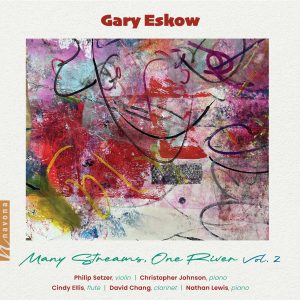
Composer Gary Eskow will be joined by Philip Setzer (violin), Christopher Johnson (piano), Cindy Ellis (flute), David Chang (clarinet), and Nathan Lewis (piano).
Format: Audio CD or Streaming
Beyond Beethoven: 20th Century Chamber Music
Les Amis Musicalles (Artist), Arni Egilsson (Composer), Bruce Broughton (Composer), Max Reger (Composer), & Cyn thia Ellis (Piccolo)
Format: Audio CD
Petite Delights: Romantic Music for Flute & Harp
by Arioso Duo featuring Cynthia Ellis
Format: Digital streaming
Never Final Never Gone
Jeremy Beck (Artist), Bruce Chamberlain (Conductor), Heather Coltman (Performer), Tatiana Razoumova (Performer), & Cynthia Ellis (Piccolo)
Format: Audio CD
On Cindy’s blog, she shares guest editorials from Flute Talk and The California Music Teacher, where musicians can find expert advice on all aspects of flute and piccolo playing. She shares below practical tips on tone production, breath control, finger technique, articulation, and phrasing, drawing from her extensive professional experience. Readers can also learn about effective practice strategies, performance preparation, and piccolo-specific techniques.